Contact Us
WhatsApp
+65 8012 2467
Email Us
contactus@thopps.com
Contact Us
WhatsApp
+65 8012 2467
Email Us
contactus@thopps.com

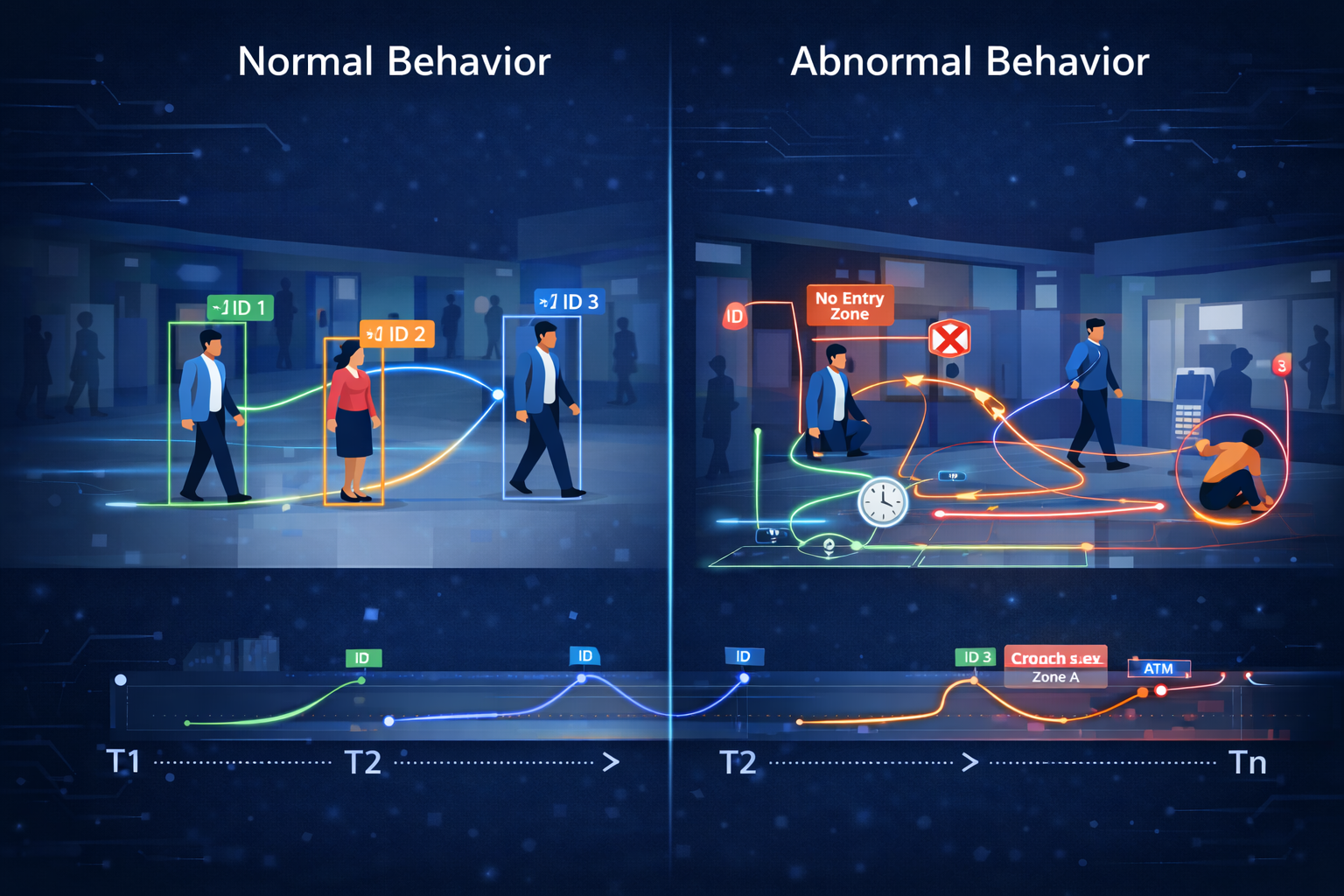
Learning Series: Foundations of Smart Surveillance
Previous: https://varsity.thopps.com/from-moments-to-meaning-the-importance-of-time-in-ai-vision
How duration, repetition, and patterns transform vision into understanding
At first glance, abnormal behaviour seems easy to define.
Someone running.
Someone stopping suddenly.
Someone entering a restricted area.
But real surveillance systems don’t work this way.
Because the same action can be normal — or concerning — depending on context.
And context is not visible in a single frame.
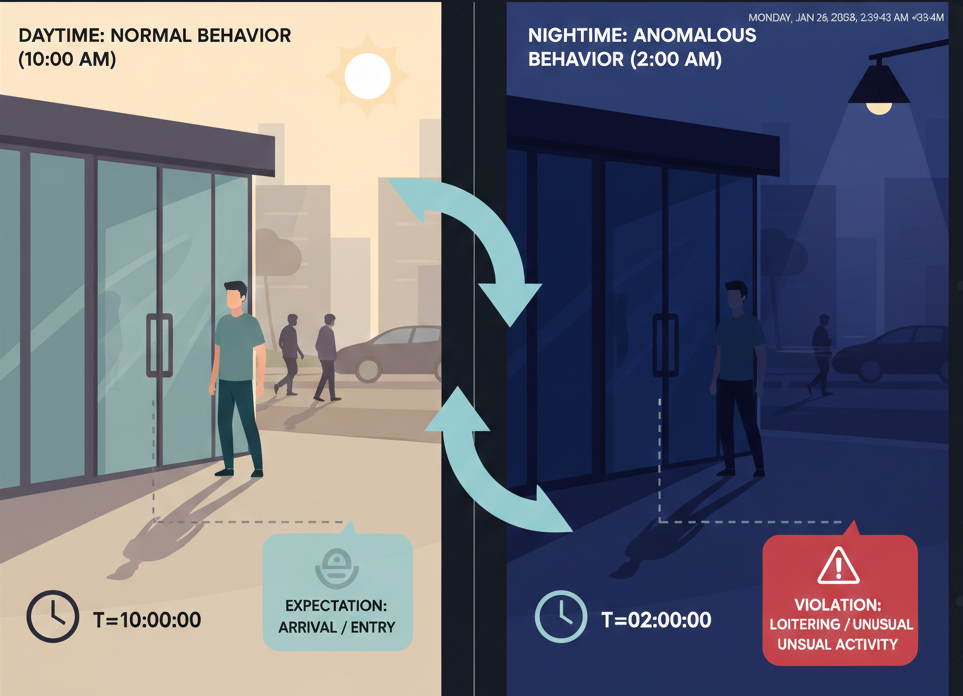
A person walking at 11 AM is normal.
The same movement at 3:30 AM may not be.
A person standing near a door for a few seconds is fine.
Standing there for several minutes changes the meaning.
Nothing changed visually.
Only the expectation did.
That’s the first lesson of intelligent surveillance.
A common misconception is that abnormal behaviour simply means something uncommon.
In real systems, rarity is irrelevant.
Deviation is what matters.
Surveillance systems don’t ask:
“Have I seen this before?”
They ask:
“Is this different from what usually happens here?”
This shift in thinking changes everything.
Normal behaviour is rarely configured manually.
Instead, systems observe quietly over time.
They learn:
From this, a baseline forms.
Not a strict rule — but a reference.
In real deployments, these baselines are often stored using:
Normal is learned, not defined.
There is no universal normal.
Normal depends on:
A crowded lobby is expected during office hours.
The same crowd at midnight is not.
That’s why modern systems maintain time-aware baselines, not one global model.
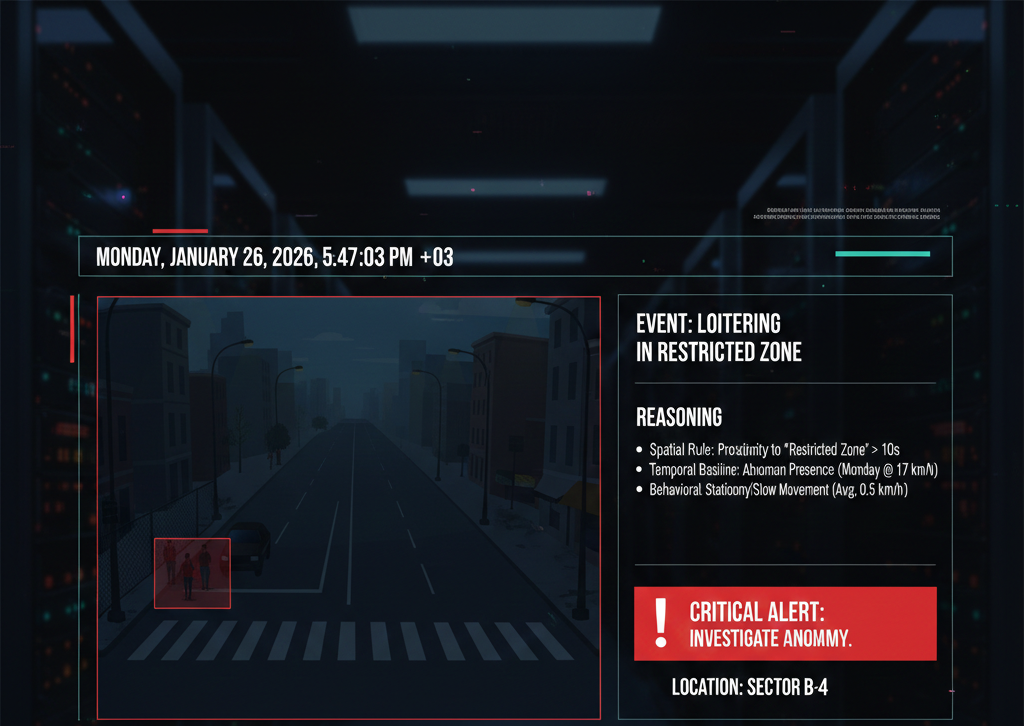
Behaviour only appears through time.
Systems measure:
Technically, this is handled using:
Without time, behaviour cannot exist — only motion.
Another hidden truth:
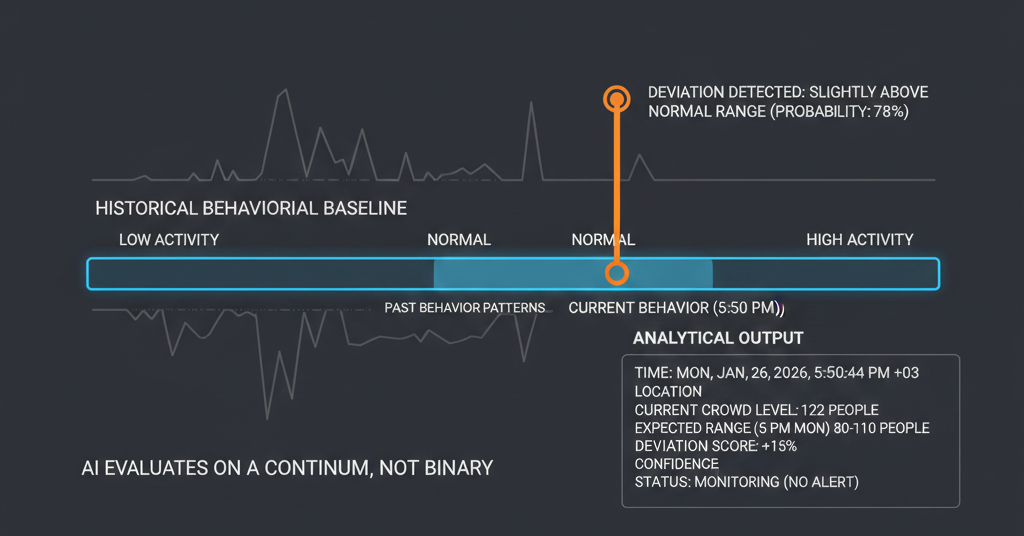
Surveillance systems don’t decide with certainty.
They estimate deviation.
Instead of saying:
“This is wrong.”
They say:
“This is outside the usual range.”
This allows systems to stay cautious rather than accusatory.
Human review always comes later.
Used widely in offices, factories, and access-controlled areas.
Examples:
Typically built using:
Used in larger environments like campuses or public spaces.
Live behaviour is compared against historical patterns.
Deviation beyond tolerance is flagged.
Often supported by:
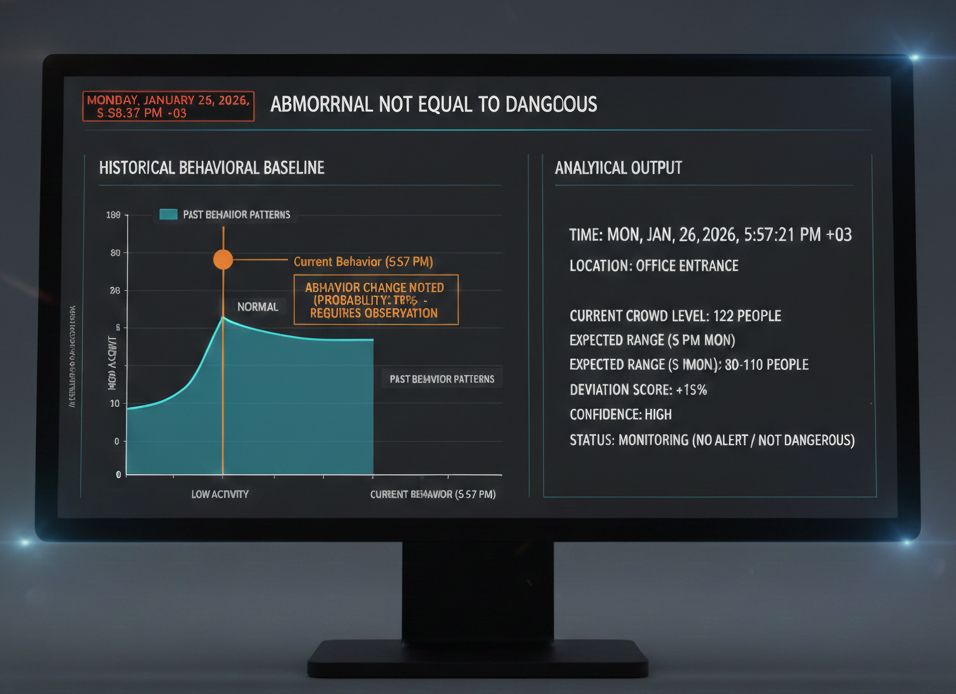
Abnormality emerges from difference — not appearance.
An anomaly simply means:
“Something changed.”
Not every change is a threat.
Good surveillance systems highlight attention —
they do not make accusations.
Normal behaviour is learned over time.
Abnormal behaviour is not rare behaviour.
It is behaviour that deviates from expectation — shaped by history, time, and context.
When systems understand expectation, surveillance stops reacting blindly
and starts reasoning intelligently.
Once behaviour is flagged as abnormal, the next challenge appears:
How does the system decide what action to take next?
In the next article, we’ll explore how surveillance systems move from observation to decision — using rules, states, and reasoning pipelines.
Next in series: Why Intelligence Cannot Be Hard-Coded